AI & Models
The Dawn of the Personal AI: How Nvidia’s New Spark Chip is Changing the PCs We Use Every Day
The Local AI Revolution: Nvidia's new RTX Spark chip brings massive AI power directly onto laptops and desktops, allowing smart AI agents to work locally without relying on the cloud. A New Era for Windows: By launching the Spark and Vera chips, Nvidia is entering the Windows PC market to directly challenge rivals like Qualcomm and Intel. Supercharging Physical Tech: Alongside new hardware, Nvidia released powerful open-source software tools to drastically speed up how we train robots and self-driving cars.
Listen to ArticleBeta
0 min listen
Quick Takeaways
•The Local AI Revolution: Nvidia's new RTX Spark chip brings massive AI power directly onto laptops and desktops, allowing smart AI agents to work locally without relying on the cloud. A New Era for Windows: By launching the Spark and Vera chips, Nvidia is entering the Windows PC market to directly challenge rivals like Qualcomm and Intel. Supercharging Physical Tech: Alongside new hardware, Nvidia released powerful open-source software tools to drastically speed up how we train robots and self-driving cars.
Imagine a computer that doesn't just run apps when you click them, but actually listens to what you need and goes to work executing multi-step tasks for you—all without sending a single byte of your personal data to a remote cloud server.
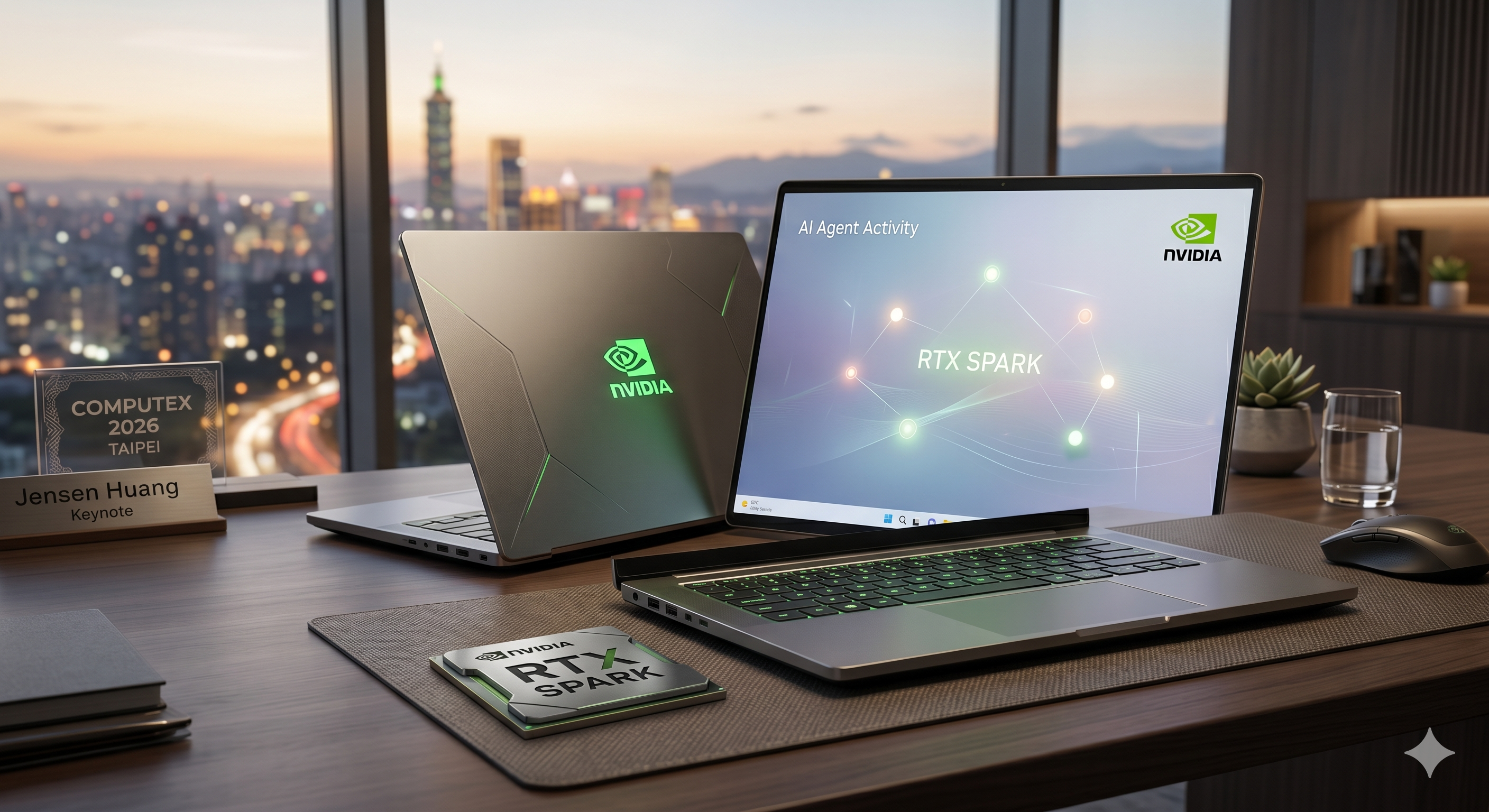
That is the future Nvidia CEO Jensen Huang laid out at the Computex tech conference in Taipei. In a major shift for the tech industry, Nvidia unveiled a groundbreaking piece of hardware called the RTX Spark superchip. Developed in partnership with MediaTek and Microsoft, this chip is designed to bring massive artificial intelligence capabilities directly onto everyday consumer laptops and desktops starting this fall.
Moving AI From the Cloud to Your Lap
For the past couple of years, using top-tier AI has felt a bit like renting brainpower. Every time you ask a chatbot a question or generate an image, that request travels to a massive, power-hungry data center miles away before returning an answer to your screen.
The RTX Spark chip changes that equation entirely. It combines a high-performance 20-core CPU with Nvidia's cutting-edge Blackwell graphics architecture and a massive 128GB of unified memory.
For the average user, this means your next laptop won't just be faster—it will be a self-contained AI powerhouse. According to Nvidia, these upcoming machines will be capable of running incredibly complex AI models right on the device. You'll be able to seamlessly edit ultra-high-resolution 12K video, render massive 3D scenes, and play visually demanding video games at blistering speeds, all while enjoying all-day battery life.
"The PC is being reinvented," Huang said during his keynote. "For forty years, you launched apps. Click. Type. With RTX Spark and Microsoft Windows, you ask—and the PC does the work."
Nvidia is already collaborating with Adobe to ensure staple creative tools like Photoshop and Premiere Pro are fully optimized to take advantage of this local horsepower.
Protecting Your Privacy with "OpenShell"
With AI agents capable of organizing your calendar, sorting through files, and automating daily chores, data privacy becomes a massive question mark. If an AI is handling your personal data, how do you keep it safe?
Because the RTX Spark processes everything locally, your data never has to leave your device. To add an extra layer of protection, Nvidia introduced a security framework called Nvidia OpenShell. Working alongside new Windows security guardrails, OpenShell acts as a personal control panel, allowing you to set strict boundaries on exactly what your digital agents can and cannot see.
You won't have to wait long to see these machines in action. Major manufacturers like Asus, Dell, HP, Lenovo, Microsoft Surface, and MSI are slated to release the first wave of RTX Spark-powered laptops and desktops this fall.
The Power Behind the Scenes: Vera and DGX Station
While the Spark chip is aimed at regular consumers, Nvidia also introduced heavy-duty hardware for scientists, developers, and tech companies.
The Vera CPU
Nvidia is making its first major play in the mainstream processor market with the Vera CPU. Boasting 88 custom computing cores and massive data bandwidth, Vera is designed to handle heavy data-shuffling tasks. AI pioneers like OpenAI and Anthropic are already adopting the chip to help power and train their next generation of smart digital assistants.
DGX Station for Windows
For businesses that need supercomputer-level power without renting out massive server rooms, Nvidia created the DGX Station. It is a heavy-duty AI workstation that fits right on a desk, giving developers the ability to run incredibly complex, frontier AI models entirely offline.
Teaching Robots to See and Do
To wrap up the keynote, Nvidia shared a gift with the global developer community by releasing a massive suite of open-source "Physical AI" tools on GitHub.
Among these tools is Cosmos 3, a highly advanced AI model that can naturally understand text, video, images, and even ambient sounds all at once. By sharing these tools openly, Nvidia hopes to shorten the time it takes to train autonomous vehicles, factory robots, and digital smart systems from months down to just a few days.
By tying together ultra-powerful local chips with open software, Nvidia isn't just trying to build a faster computer—they are trying to build a companion that can understand the physical world right alongside us.
The $5 Trillion Engine Driving the AI Era.
To truly understand why these announcements matter, you have to look at the massive footprint of the company behind them. Nvidia is no longer just a hardware manufacturer making graphics cards for video games. It has evolved into the foundational engine of the entire global artificial intelligence ecosystem, establishing a near-monopoly on the silicon that makes modern AI possible.
This hyper-growth has culminated in an eye-watering market valuation crossing $5 trillion, cementing Nvidia as one of the absolute most valuable companies on the planet. The trajectory is stunning: the company crossed the $1 trillion mark in mid-2023, meaning it managed to quintuple its entire value in roughly three years. This rapid expansion highlights how fiercely the tech sector is competing to secure Nvidia's hardware.
NVIDIA's Unprecedented Market Capitalization Growth
[June 2023]  █ $1.0 Trillion
[June 2026]  █████████████████████████ $5.1+ Trillion
An unprecedented surge in infrastructure spending fuels this massive valuation. Across the globe, tech giants like Microsoft, Amazon, Meta, and Alphabet are pouring billions into building out specialized data centers. Industry projections indicate that overall AI infrastructure capital expenditures could scale toward $1 trillion annually by 2027. Right now, almost all of that money flows directly through Nvidia's ledger because their proprietary hardware architecture, paired with their massive software ecosystem called CUDA, creates a system that competitors simply cannot match.
The Pivot from Data Centers to Your Pocket
Until now, Nvidia's dominance was concentrated entirely behind closed doors inside giant server farms. If you used ChatGPT, generated an AI image, or ran an automation script, you were indirectly using Nvidia's backend enterprise chips.
The Computex announcements signal a massive strategic shift. Nvidia is taking the raw processing frameworks that made them an infrastructure monopoly and distilling them into chips meant for consumer devices. By deploying the consumer-focused RTX Spark and the enterprise-tier Vera CPU, Nvidia is closing the loop. They want to power the massive servers running the world's largest models, the localized desktop stations where developers fine-tune them, and the thin-and-light laptops sitting on your office desk.
This multi-layered approach creates a massive competitive wall. When a developer builds an AI model on an Nvidia-powered cloud, tests it locally on a DGX Station, and deploys it to consumers using RTX Spark laptops, they never have to leave Nvidia's hardware architecture. This unified ecosystem makes it incredibly difficult for rival chipmakers to break Nvidia's hold on the market.
Ultimately, this shift represents the democratization of raw computing power. By transitioning AI workloads away from massive remote cloud facilities and placing them directly on physical consumer hardware, Nvidia isn't just selling a new computer component—it's reshaping how humanity interacts with everyday technology. The PC is shifting from a passive tool that waits for your commands into an active, localized collaborator that can think, reason, and act right alongside you.
-- Himanshu G
Rate HIMANSHU G.T's Analysis
Your feedback directly trains our AI agents to improve.