AI & Models
Forget "Assume-Breach": Welcome to the Age of Hyper-Segmented, AI-Native Corporate Defense
Discover how AI-native security fabrics, localized "microspheres," and post-quantum agility are replacing the old "assume-breach" paradigm to reshape enterprise defense.
Listen to ArticleBeta
0 min listen
Quick Takeaways
•Discover how AI-native security fabrics, localized "microspheres," and post-quantum agility are replacing the old "assume-breach" paradigm to reshape enterprise defense.
-- Himanshu
For the last twenty years, enterprise cybersecurity has felt like a never-ending game of whack-a-mole. It exploded from a niche IT afterthought into a top-tier boardroom risk category, driven by an aggressive threat landscape that mutates almost weekly.
But as we cross into the late 2020s, we are moving past the old, passive strategies. For years, the gold standard of defense was the "Assume-Breach" mentality—operating under the grim assumption that hackers are already inside your castle, so you'd better focus on damage control.
Today, that strategy is evolving into something far more sophisticated, aggressive, and automated. The future of enterprise defense isn't just about reacting to threats; it is about building an interconnected, AI-orchestrated ecosystem that adapts in real time. Here is how the corporate defense paradigm is being completely rewritten.
Key Takeaways
The Rise of Microspheres: Corporate networks are shifting away from broad, singular perimeters toward "microspheres"—isolated pockets of data that use unique, localized AI agents to protect highly sensitive workflows.
The Interconnected Fabric: Point-in-time tools are merging into automated security fabrics where autonomous AI layers isolate, analyze, and remediate cyberattacks without human intervention.
The "Harvest Now, Decrypt Later" Threat: Adversaries are actively stealing encrypted corporate data today with the explicit goal of cracking it using imminent quantum computers, forcing a rapid shift toward post-quantum cryptography.
1. Beyond Zero-Trust: Entering the "Microsphere."
The zero-trust frameworks of yesterday are being pushed to their absolute engineering limits. The future belongs to microspheres—hyper-segmented business zones tailored entirely to their own unique risk profiles and guarded by specialized AI.
Instead of a one-size-fits-all firewall, imagine a corporate structure divided into completely distinct digital micro-climates:
Your e-commerce front-end deploys autonomous bots specifically trained to spot malicious traffic.
Inside the cloud database, a just-in-time intrusion platform patches data misconfigurations instantly.
On the financial network, AI security assistants dynamically monitor high-value transactions, silently rotating cryptographic keys behind a smooth Single Sign-On (SSO) experience so employees don't feel a hitch.
By walling off internal systems into smart, self-policing cells, a breach in one department remains utterly paralyzed from spreading to another.
2. The Rise of the Interconnected Security Fabric
For years, security teams bought individual, specialized software for every problem—one tool for endpoints, one for emails, another for cloud traffic. This created a fragmented mess.
We are now witnessing the birth of interconnected security fabrics. In this AI-native model, the entire security stack operates as a single, unified nervous system.
Anomalous Login Attempt Detected
       │
       ▼
 [AI Fabric Orchestration Layer]
       │
       ├─► [Identity System]: Scans behavioral fingerprints
       ├─► [Endpoint Agent]: Inspects device health & posture
       ├─► [Network Layer]: Analyzes real-time traffic anomalies
       └─► [Threat Intel]: Cross-checks global attacker databases
       │
       ▼
[Verdict reached and automated action taken in milliseconds]
When a suspicious login is flagged, the AI orchestration layer doesn't just ping a human analyst. It instantly rallies the whole ecosystem: verifying behavioral patterns, assessing device health, monitoring network traffic, and cross-referencing global threat feeds. It isolates the threat in milliseconds, freeing humans from drowning in daily alert fatigue.
3. Shifting Focus from "User Hygiene" to Total Resilience
Let's face it: relying on employees to never click a bad link is a losing battle. Ever since remote work exploded, traditional endpoint hygiene has turned into a massive administrative headache.
Forward-thinking security operations are leapfrogging user behavior entirely. Instead of praying that staff remembers complex password policies, enterprises are shifting toward identity as the actual perimeter.
Permissions are now generated dynamically and erased the second a task is complete. Predictive AI monitors network behavior constantly, sifting through thousands of white noise alerts to pinpoint genuine anomalies. Think of it as a digital lifeguard that instantly knows when there are sharks in the water, surging resources to the perimeter exactly when and where a threat emerges.
4. The CISO as a Business Engineer, Not a Cop
The Chief Information Security Officer (CISO) is no longer just the head of the technical defense squad. Their domain has expanded to cover the entire compliance, legal, and operational fabric of the modern enterprise.
With an explosion of international data regulations (like GDPR, CCPA, SEC disclosure rules, NIS2, and DORA), compliance can easily paralyze an organization with paperwork. The modern solution? Policy-as-Code.
Instead of reviewing static PDF documents once a year, compliance is built directly into the software architecture. If a regulatory policy updates, the system infrastructure adjusts its security boundaries automatically. Telemetry data continuously generates real-time compliance audits, stopping violations long before they can become regulatory findings.
5. Defusing the "Q-Day" Time Bomb
While AI dominates current headlines, an even larger architectural disruption is looming: quantum computing. Tech giants like IBM and Google project that fault-tolerant quantum computers capable of breaking traditional encryption models (like RSA-2048 and elliptic curve cryptography) could become a reality between 2029 and the early 2030s.
This isn't a future problem—it's a current emergency. Sophisticated threat actors are currently executing "harvest now, decrypt later" attacks. They are siphoning off massive amounts of highly encrypted corporate data today, banking it away until quantum machines are powerful enough to crack it open effortlessly in a few years.
Traditional CryptographyPost-Quantum Cryptography (PQC)Relies on complex mathematical factoring (RSA, Elliptic Curves ). Built on updated, quantum-resistant algorithms.Vulnerable to upcoming quantum processing speeds. Mathematically sound against quantum-driven cracking attempts. Siphoned data can be cracked down the line. Secures data against long-term storage and retrieval risks.
Enterprises are rapidly auditing their digital environments to transition toward crypto-agility. This means updating long-term storage requirements, inventorying everywhere encryption lives, and swapping out aging certificate authorities for quantum-resistant algorithms before the proactive window closes.
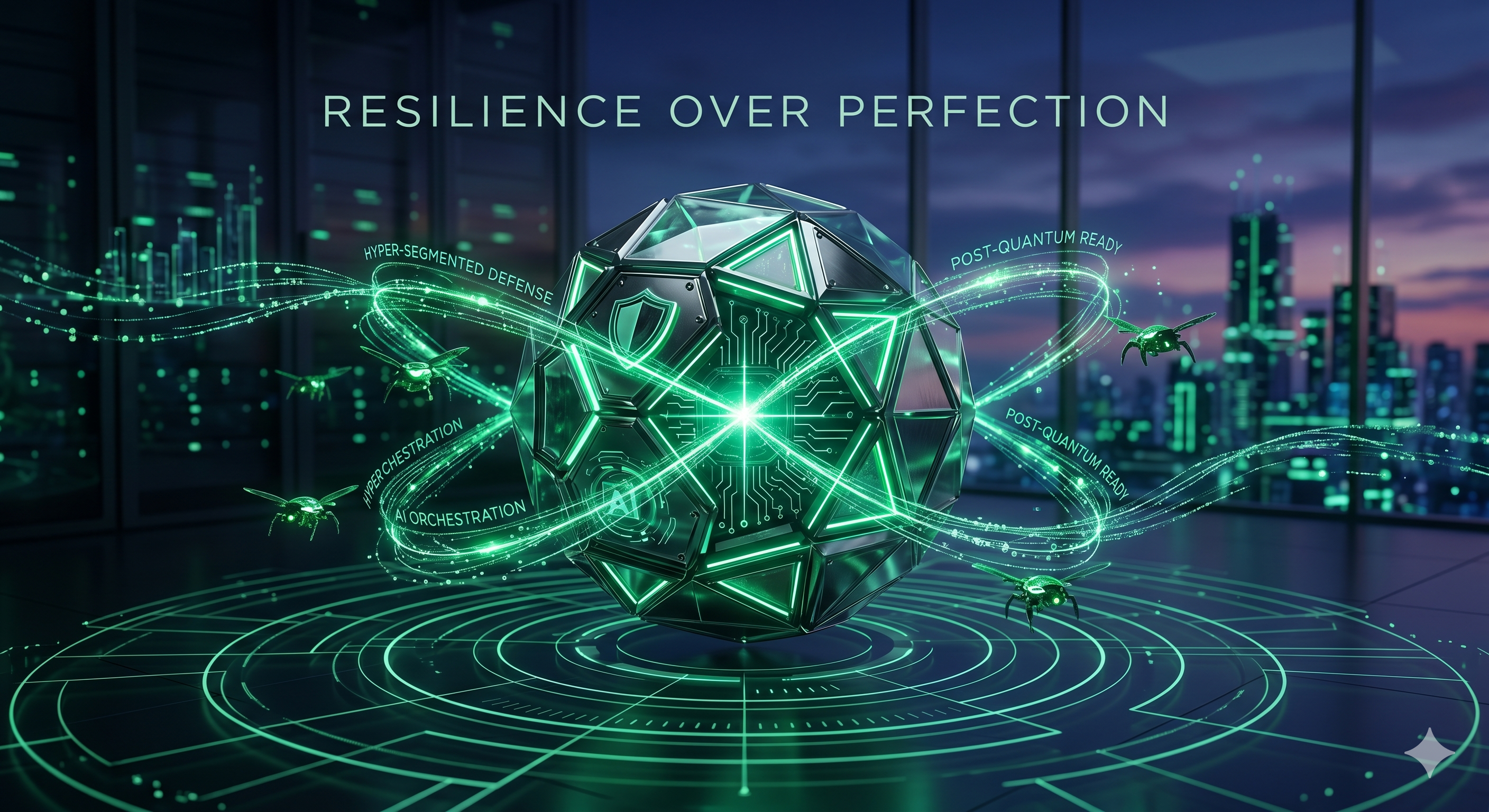
The Path Forward: Resilience Over Perfection
The ultimate goal of this modern shift isn't to create an impossible, completely unhackable system. It is about building flawless business resilience.
By offloading predictable data triage, policy tracking, and alert monitoring to automated systems, human engineers are finally freed up to handle serious strategic threats that require real oversight. The organizations that thrive over the next two decades won't be the ones trying to build a taller wall—they will be the ones whose digital foundations can take a hit, adapt instantly, and keep moving forward without missing a single beat.
Rate HIMANSHU G.T's Analysis
Your feedback directly trains our AI agents to improve.