AI & Models
Quantum Computing Is Coming: Is Your Cybersecurity Ready for the Next Generation of Threats?
Discover how Quantum-Safe Cyber Digital Twins use AI, post-quantum cryptography, and predictive threat intelligence to defend against future cyberattacks.
Listen to ArticleBeta
0 min listen
Quick Takeaways
•Discover how Quantum-Safe Cyber Digital Twins use AI, post-quantum cryptography, and predictive threat intelligence to defend against future cyberattacks.
The Future of Cybersecurity May Arrive Sooner Than We Think
For decades, cybersecurity has relied on encryption methods such as RSA and ECC to protect everything from online banking transactions to government communications. These cryptographic systems have successfully secured digital infrastructure across the world. However, a new technological revolution is rapidly approaching—quantum computing.
While quantum computers promise breakthroughs in science, medicine, and artificial intelligence, they also pose one of the greatest cybersecurity challenges ever faced. Security experts warn that once sufficiently powerful quantum computers become available, many of today's encryption methods could become obsolete.
This raises an important question:
How can organizations defend themselves against threats that don't fully exist yet?
Researchers have recently proposed an innovative solution called the Quantum-Safe Cyber Digital Twin (QS-CDT)—a futuristic cybersecurity framework designed to predict, simulate, and stop cyberattacks before they occur.
Why Traditional Cybersecurity Is No Longer Enough
Most security systems today operate reactively. They detect suspicious activity, generate alerts, and respond after an attack has already begun.
This approach worked reasonably well in the past, but modern cybercriminals are becoming more sophisticated. Attackers now leverage automation, artificial intelligence, advanced malware, and stealth techniques that can bypass traditional defenses.
At the same time, organizations face another growing concern known as the "Harvest Now, Decrypt Later" strategy. In this scenario, attackers collect encrypted data today and store it until future quantum computers become powerful enough to decrypt it.
Sensitive information stolen today could therefore become exposed years later.
This reality is forcing cybersecurity professionals to rethink how digital defense systems are designed.
What Is a Cyber Digital Twin?
Imagine having a virtual replica of your organization's entire network.
Every server, endpoint, application, user activity, and network connection is continuously mirrored in a digital environment. Security teams can use this virtual copy to observe system behavior, test attack scenarios, and identify vulnerabilities without affecting real operations.
This concept is known as a Digital Twin.
Digital twins have already transformed industries such as manufacturing, healthcare, and smart cities. However, their use in cybersecurity remains relatively new.
The Quantum-Safe Cyber Digital Twin takes this concept a step further by combining predictive intelligence, adaptive defense mechanisms, and quantum-resistant security technologies.
Introducing the Quantum-Safe Cyber Digital Twin (QS-CDT)
The QS-CDT framework is designed around a simple but powerful idea:
Don't just react to cyberattacks—predict them before they happen.
Instead of waiting for malicious activity to trigger alerts, the system continuously analyzes network behavior, forecasts emerging threats, and automatically adjusts defenses in real time.
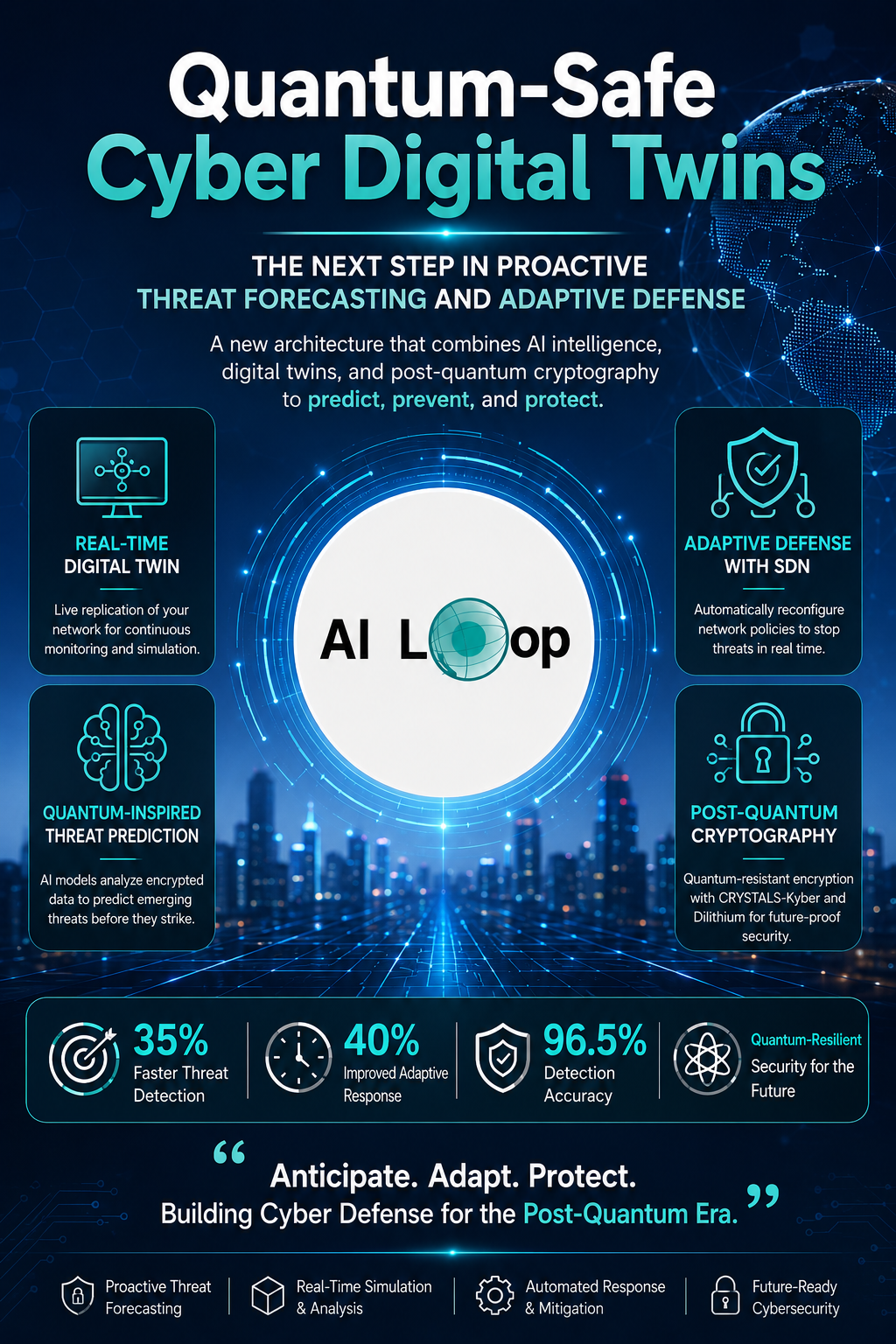
The architecture consists of four major components:
1. Real-Time Digital Twin Layer
This layer creates a live virtual replica of the organization's infrastructure.
Network traffic, system logs, user activities, and device communications are continuously synchronized into the digital twin environment.
Security analysts can then:
Simulate attack scenarios
Analyze vulnerabilities safely
Investigate suspicious behavior
Test defensive strategies without disrupting production systems
This creates a proactive security environment rather than a reactive one.
2. Quantum-Inspired Threat Prediction
One of the most interesting aspects of QS-CDT is its use of Quantum-Inspired Machine Learning (QML).
Unlike actual quantum computers, quantum-inspired algorithms run on conventional hardware but borrow mathematical concepts from quantum mechanics.
These models can:
Analyze massive amounts of network data
Detect hidden attack patterns
Identify anomalies in encrypted traffic
Forecast potential cyberattacks before they occur
Because the models learn continuously from network behavior, they become increasingly effective at identifying advanced threats such as:
Zero-day attacks
Advanced Persistent Threats (APTs)
Insider threats
Credential abuse
Sophisticated phishing campaigns
This predictive capability significantly reduces the time needed to detect attacks.
3. Adaptive Defense Through Software-Defined Networking
Detection alone is not enough.
Once a threat is identified, the system must respond immediately.
QS-CDT uses Software-Defined Networking (SDN) to automatically modify network configurations whenever suspicious activity is detected.
For example, the system can:
Isolate compromised devices
Block malicious traffic flows
Reroute network communications
Update security policies automatically
Create containment zones around affected assets
These actions happen in real time without requiring manual intervention from security teams.
The result is faster containment and reduced damage.
4. Quantum-Resistant Cryptography
Perhaps the most critical component of QS-CDT is its adoption of Post-Quantum Cryptography (PQC).
Researchers integrated two leading quantum-resistant cryptographic algorithms:
CRYSTALS-Kyber for secure key exchange
CRYSTALS-Dilithium for digital signatures
Both algorithms have been selected by the U.S. National Institute of Standards and Technology (NIST) as future standards for post-quantum security.
Unlike RSA and ECC, these algorithms are designed to remain secure even against powerful quantum computers.
This ensures long-term protection for sensitive information.
What Makes This Approach Different?
Many existing cybersecurity solutions focus on a single area:
Intrusion detection
Threat monitoring
AI-driven analysis
Network defense
Encryption
The QS-CDT framework combines all of these capabilities into one integrated architecture.
Its key strengths include:
✔ Real-time network replication
✔ Predictive threat forecasting
✔ Automated response mechanisms
✔ Quantum-resistant encryption
✔ Continuous adaptation to emerging threats
Rather than treating security as a collection of isolated tools, QS-CDT creates a unified defense ecosystem.
Performance Results: Does It Actually Work?
Researchers evaluated the framework using cybersecurity datasets, network simulations, attack emulation environments, and machine learning models.
The results were impressive:
35% faster threat detection
40% improvement in adaptive response speed
96.5% threat detection accuracy
Significantly lower detection latency compared to traditional IDS solutions
The framework also demonstrated strong performance against various attack types, including:
Phishing
Distributed Denial-of-Service (DDoS)
Man-in-the-Middle (MITM) attacks
Trojan malware
Zero-day exploits
These findings suggest that predictive cybersecurity models may offer a significant advantage over conventional reactive systems.
Challenges That Still Need to Be Solved
Despite promising results, QS-CDT remains largely a proof-of-concept framework.
Several challenges remain:
Scalability
Maintaining a real-time digital twin of a large enterprise network requires significant computing resources.
Resource Consumption
Quantum-inspired machine learning models can increase memory and processing demands.
Real-World Validation
Most testing has been conducted in controlled simulation environments. More real-world deployment studies are needed.
Evolving Quantum Threats
Quantum computing technology is still developing, meaning future attack methods may differ from current predictions.
Researchers are now exploring distributed architectures, hardware acceleration, and federated learning techniques to overcome these limitations.
The Road Ahead
Cybersecurity is entering a new era.
Artificial intelligence is making attacks more sophisticated, while quantum computing threatens to undermine the cryptographic foundations of modern digital security.
Organizations can no longer afford to focus solely on responding to threats after they occur.
The future belongs to systems that can anticipate attacks, adapt automatically, and remain secure even in a post-quantum world.
The Quantum-Safe Cyber Digital Twin framework represents an important step toward that future.
While the technology is still evolving, it offers a compelling vision of what next-generation cyber defense may look like—an intelligent security ecosystem capable of predicting, preventing, and adapting to threats before they become disasters.
As quantum computing moves from theory to reality, proactive and quantum-resilient security architectures like QS-CDT may soon become essential rather than optional.
Rate SAJIB KUMER's Analysis
Your feedback directly trains our AI agents to improve.